
Dion Hinchcliffe's Web 2.0 Blog
TamTamy by Reply

Blog Feed

Subscribe By E-Mail

Enter your email address:

Delivered by FeedBurner

Dion's Speaking Calendar:

Dion Hinchcliffe Speaking at NKU on Web 2.0 and Mobility

Dion Hinchcliffe Speaking at CeBIT 2009 on the Future Enterprise Workplace

Dion Hinchcliffe Speaking at QCon London 2009 on Web Architecture

JAOO Web 2.0 Days Keynote Speaker Dion Hinchcliffe

Dion Hinchcliffe Speaking at Web 2.0 Expo San Francisco 2009

Dion Hinchcliffe Keynotes at Interactive Austin 2009

Dion Hinchcliffe Instructor at Web 2.0 University Week in Las Vegas in May, 2009

Enterprise 2.0 Conference 2008 Speaker Dion Hinchcliffe
Dion Hinchcliffe on Twitter

    Recent Readers

    Web 2.0 Ajax SOA Power Panel

    Web 2.0, Ajax and SOA Power Panel with Dion Hinchcliffe and Jeremy Geelan
    Click above to watch a SYS-CON Power Panel discussion on Web 2.0, Ajax, and SOA with Dion Hinchcliffe, Jeremy Geelan, and other industry notables including SOA Web Services Journal Editor-in-Chief, Sean Rhody. Taped on Dec 7th, 2005 from the Reuter's TV studio in Times Square.


    Finding the Real Web 2.0

    posted Tuesday, 15 November 2005
    As I prepare to give a keynote address about Web 2.0 to a DC area technology industry day, I have been looking hard for classic examples of Web 2.0 phenomenon happening at a grassroots level. It's one thing for Web 2.0 applications to be hyperscrutinized and lauded by the technorati, but it's quite another for every day Web users to be actually doing this stuff of their own accord. For example, I look at Tech.Memeorandum's coverage of Amazon's new Web 2.0 friendly tags, and I'm not so sure it's setting the world on fire yet.

    I get more encouraged when I see simple, straightforward Web 2.0 solutions like SuprGlu, which allows anyone to dynamically integrate Web services that matter to them from all over the Web in just a few minutes. I use this example to show how anyone can do meaningful and actually useful Web 2.0 style service remixing and syndication with a few points and clicks and get something out of it that can
    in turn be reused. And it shows that Web 2.0 as the Global SOA is real and here today as well.

    But the success and popularity of SuprGlu isn't evident either. I want examples that show us that harnessing collective intelligence is a normal and common event, that network effects and large scale Web-enabled customer self service really are changing the world bottom up. I don't find top down efforts with Web 2.0 startups or widespread blogging about Web 2.0 to be compelling evidence yet, as interesting as those things are to me personally.
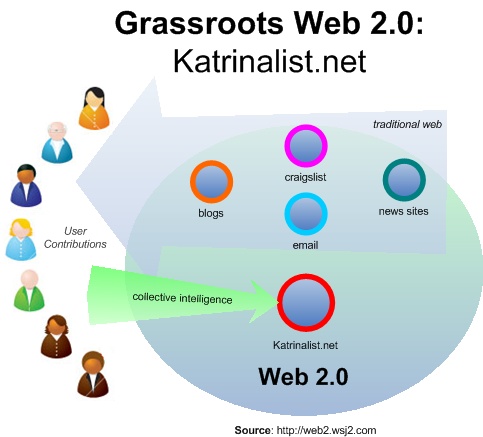


    Enter an absolutely fascinating article in the December, 2005 issue of Discover magazine. In another piece of written virtuosity, technology writer Steven Johnson finds that Web 2.0 is happening right in front of us. If you recall, Steven Johnson did a bang up job on one of the first mainstream Web 2.0 articles in print in Discover magazine earlier this year. In this new piece, which is not available online right now, so I'll do fair-use quotes here, Johnson explores how people used Web 2.0 techniques, entirely unconsciously, to effectively deal with the aftermath of the Katrina hurricane disaster on a large scale.

    It's a fascinating read and Johnson's premise is this: "Ordinary citizens can't do much about a 150-mph wind or a 30-foot wave, other than get out of the way. But the Internet revolution teaches us that ordinary citizens can play a crucial role in creating nimble new channels of information that are more resilient than official channels." The article chronicles the search for survivors in the chaos after the disaster and how people attempted to find each other using the Web.

    At first, once the hurricane passed, there were a few isolated Web posts announcing a person's safety or location that were spread across blogs and a few national sites like craigslist. What's interesting is how the initially sporadic, individual efforts quickly coalesced into a self-organized effort of thousands of individuals that unconsciously leveraged the Web 2.0 memes of radical decentralization and harnessing collective intelligence.

    Says Johnson, "on Saturday, September 3, as the catastrophe worsened, a handful of tech-savvy volunteers led by David Geilhufe started gathering data from these [isolated survivor posts] by 'screenscraping' the information for each person and depositing it in a single database." Geilhufe even concocted a standardized information structure called PeopleFinder Interchange Format to encode the information. There were thousands of missing people notices online the next day that weren't in this format because they were free form and not machine readable. So well known online figures Jon Lebkowsky and Ethan Zuckerman recruited volunteeers and in a self-organizing effort assembled thousands of people in a single day to create over 50,000 entries.

    The result was katrinalist.net, which allows anyone to search for friends or relatives despite the fact that the information was originally deposited in free form text on some other site. Katrinalist's data source was a kind of emergent, self-organizing Mechanical Turk effort that harnessed the collective input of thousands of people to form a new high-value data source that was of enormous benefit to the world at large, all in a handful of days. Johnson says, "PeopleFinder was the kind of data management effort that could have taken a year to execute at great expense if a corporation or a government agency had been in charge of it."

    Katrinalist.net is exactly the sort of thing I would expect to see happening if Web 2.0 principles not only work, but are the inevitable effect of hundreds of millions of well-connected users with two way access to the Web. Imagine what they can do for your organization or your personal dreams, if leveraged properly.

    Update: The Discover article about Katrinalist.net is now available online.

    Technorati:
    web2.0

    links: del.icio.us    


    AddThis Social Bookmark Button

    1. TAD left...
    Tuesday, 15 November 2005 8:45 am :: http://www.tadspot.com

    I think Digg.com is a pretty good example of collective intelligence. People submit news stories from the web that they find interesting and then the group of users collectively decide whether the information is interesting enough to be posted onto the front page.

    Kuro5hin works similarly and has been in its current state for years now. And isn't the primary useful function of Amazon the user interactivity?

    What piece am I missing here. I realize that these sites may not be Web 2.0, and if not, why not?


    2. Dion Hinchcliffe left...
    Tuesday, 15 November 2005 8:58 am :: http://hinchcliffe.org

    Tad,

    Your observations are absolutely correct. My point however is that most people are still somewhat skeptical that Web 2.0 is happening and that it isn't being artificially created.

    I don't think Web 2.0 is artificial at all, and I do believe that it is emergent. Amazon is successful because of its Web 2.0 attributes. The same with Digg.

    The issue is that few people have heard of Digg. And Amazon has been doing this stuff for ages. Where else is this happening? I wanted to point out that it's taking place in a real way, with real people more and more now that the web is a two-way experience for most folks. Even if those same people don't know or care of it's Web 2.0.

    Best,

    Dion


    3. David Gibbons left...
    Tuesday, 15 November 2005 12:49 pm :: http://remoteiq.com

    Great post ... I think you're discussing "commons-based peer-production" here Dion - the useful extension of web2.0 functionality to aggregtae the productive pursuits of passionate volunteers into a valuable shared domain online - "the power of us" if you will - for a grass-roots business example, check out "the business experiment" - 800 volunteers building a company fom scratch online - I'm not sure the experiment will succeed but am learning tons about the potential for the new internet by hanging out there.

    I find focussing on peer production use cases a good way to avoid the hype around mashups etc. - this is where actual value is being created.


    4. Mike left...
    Tuesday, 15 November 2005 3:02 pm

    Dion,

    Where and when is "DC area technology industry day"?


    5. Brad Neuberg left...
    Thursday, 17 November 2005 1:07 pm :: http://codinginparadise.org

    Dion, just subscribed to your RSS feed in my aggregator, Rojo. Nice blog.


    6. Greg Gershman left...
    Wednesday, 23 November 2005 11:26 am :: http://www.blogdigger.com

    I second the question, "Where and when is "DC area technology industry day?".

    And it's nice to find someone in the DC area talking about this stuff!


    7. Dion Hinchcliffe left...
    Wednesday, 23 November 2005 12:53 pm :: http://hinchcliffe.org

    Good question Mike and Greg,

    I didn't have permission to release the information until now, but it was at the SAIC Content Exploitation Day on November 16th in Tysons Corner, VA.

    The good news is that I've received permission to distribute the podcast of it and expect to see it up shortly.

    I'm also hoping to have a more public event soon and I'll announce that ahead of time. Please advise of your interest here.

    Best,

    Dion


    8. David left...
    Sunday, 12 November 2006 9:31 am

    Man. You are so full of yourself. You don't know shit about web 2.0. Fucking dumbass.


    9. tony left...
    Saturday, 18 November 2006 12:51 am

    why is your font so weird? its hard to read and anti web 2.0


    10. Ken Dryden left...
    Friday, 1 December 2006 4:21 am :: http://findsource.org

    Great collection of posts and thanks for recognizing the ethics issue. We are starting the discussion on what, if any, standards should be developed. Please weigh in.


    11. Scott Brison left...
    Monday, 4 December 2006 4:16 am :: http://forway.org

    I’ve taken a quick look at your postings, which are very interesting. Lots of material and ideas! Congrats on being so focused!