

I’ve spent the last few days keeping track of the seemingly endless stream of news and blog coverage about Google’s new OpenSocial model for social networking applications. OpenSocial has been described by some as Google’s industry “chess move” to outmaneuver and corner Facebook. This is fascinating set of developments to watch since Google’s own growing social networking platform, Orkut, was eclipsed by Facebook in terms of overall traffic back in September.
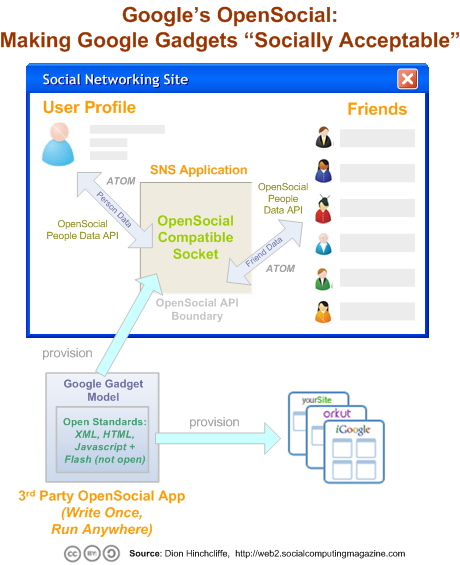
Unless you’ve been hiding under a rock lately, you know that Facebook is presently the industry darling in social networking, having largely pushed MySpace off the industry’s stage, as it seems to offer a more compelling model for social interaction to users overall. Just as importantly, Facebook also lets any other company that wants to join in party do so by building 3rd party Facebook applications, of which over 7,100 now exist, making Facebook increasingly rich in functionality and content by leveraging the creative capacity at the edge of the Web. In the Web 2.0 era (and in all computing eras before), the central truism is that a platform beats an application every time. This applies here with a vengeance and MySpace and other social networking sites have suddenly rushed to embrace openness and 3rd party widgets and gadgets to such an extent that MySpace has thrown in with Google on OpenSocial.
So the damage is done and in the fickle world of online social networking, Facebook currently has the upper hand. This demonstrates yet again a powerful but counterintuitive aspect of networked software: the more control you give away, the more value you can get back.
Read my ZDNet coverage on how Facebook got ready to overtake MySpace and the challenges of setting up shop inside in Facebook.
However, much of the blogging around OpenSocial would have you believe that has Google now trounced the competition with a strategic move that counters Facebook’s open SNS platform move with an open SNS application model that can work everywhere else too. At least, that is, the other social networking sites that support OpenSocial’s API.
But as Don Dodge noted in his OpenSocial coverage this isn’t going to stop developers from building apps natively for Facebook any time soon and will have little practical effect on existing Facebook users for quite a while. Not to mention the rest of the Web, since not even a single real OpenSocial application yet exists.
That’s not to say however that OpenSocial doesn’t have its advantages. Joe Kraus, a Director of Product Management at Google, wrote today on the Official Google blog that OpenSocial will make life easier for developers “because it makes it easier for them to focus on making their web apps better; they get lots of distribution with a lot less work. It’s good for websites, because they can tap into the creativity of the largest possible developer community (and no longer have to compete with one another for developer attention). And finally, it’s good for users, because they get more applications in more places.“
So, despite the early beginnings, does OpenSocial make sense from the production side of social networking applications? It still remains to be seen, despite the enormous amount of early partner support for it, if the consumption side in terms of these kinds of applications really generates value. Most of the applications on Facebook provide so little actual utility that they are barely worth installing. While making these mini-apps portable between social networking sites is convenient — and it probably will appreciably increase the total number of available social applications — it’s really people and the network effect they represent for a given social networking site that makes the site truly valuable. In other words, if my friends and colleagues aren’t on the social networking site I use, then that site is of little or no use to me, even if I can take my apps with me.
It’ll be interesting to see what ultimately happens to OpenSocial. I suspect it will actually see fairly good uptake since it’s based on the highly successful Google Gadgets model, for which over 23,000 different Gadgets presently exist. But will it change the playing field in the social networking wars? Probably not as much as a federated social identity would. Federated social identity could potentially let you exist and participate simultaneously in all the social networks you wanted to at once using one set of social metadata you control. That’s probably a lot closer to the Facebook killer that so many are looking for and things like openid are bring that world closer to reality all the time.
In the meantime, here’s the six things you absolutely have to know about OpenSocial to have an opinion about it:
6 Essential Things You Need To Know About Google’s OpenSocial
- OpenSocial only offers the lowest common denominator, not the full richness of each social networking platform. While application developers can create apps using the OpenSocial model and they will be able to run on dozens of different social networking sites, OpenSocial can’t help you leverage the full capabilities of the site it runs on. Social networking site APIs aren’t anywhere as complex as say, the Windows APIs, but we’ve seen this before with platforms such as Java, where the development model can’t support the full capabilities of the underlying operating systems. Like Java, write once, test everywhere is the name of the game for OpenSocial and while economies in this model certainly exist, a single universal widget model tends to discourage product differentiation in favor of broad distribution. This means to get at the full richness of the underlying platform and create a competitive product, you have do custom coding for that site and you’ve just broken the reason to use a common application model.
- OpenSocial is largely based on open standards and there’s only minor developer lock-in. Overall, it actually seems pretty safe to do a lot of your social application development using OpenSocial. It uses the essential browser open standards of XML, HTML, Javascript, and the data formats are all ATOM and RESTful/WOA. You can even host Flash content and functionality inside the OpenSocial application as long as you don’t break the rules. Finally, most of the really popular development platforms, including Ruby on Rails, can support the server-side API. All in all, Google seems to have stuck to a fairly open and non-proprietary model including avoiding crufty proprietary markup. OpenSocial documentation and sample code all uses the Creative Commons licensing and Apache 2.0, and the OpenSocial FAQ says everything will be open sourced at some point. Kudos for this open stance, Google.
- OpenSocial is a real doorway to social networking data portability as well as potential security holes. A site that supports OpenSocial applications provides that application with all the people data in that user’s account. Their own info as well as their friends. This can be used to export user’s social data from sites that don’t support themselves directly and it could even be used to knit together a person’s social data across other social sites that support OpenSocial, with properly designed 3rd party apps. But it also opens the door to security problems and expect to see that security, cross-site scripting, and exploits become an issue over time, as it always does when platforms open up to the rest of the world. Update: Michael Arrington has reported that the first OpenSocial app has now been hacked.
- OpenSocial is simple and straightforward but also capable of developing full-blown, rich Internet applications. And without server-side infrastructure. Developers can simply innovate with a few bits of markup and procedural code and drop it into the OpenSocial ecosystem and leverage the massive audiences and scalable infrastructure of OpenSocial compliant sites. OpenSocial even supports powerful interactive Web user interface models like Ajax explicitly. Like we saw last year, with the new productivity-oriented Web development platforms, this will change what’s possible while also creating mountains and mountains of relatively useless, uninteresting apps amongst a few real gems. But a lot more wildflowers will bloom on the OpenSocial landscape and some will likely rise up and show us how useful these applications can be.
- OpenSocial is from Google and excessive philanthropy should not be expected. Google almost certainly thinks OpenSocial will ultimately be very good for Google, if not outright bad for a few others (probably Facebook). While the openness is encouraging, if OpenSocial is successful, Google has a plan to make that success work for it. Those plans may not always be to the benefit of everyone playing under the OpenSocial umbrella. User beware.
- A new era in competency in social software is being ushered in by models like OpenSocial. A lot more social applications are being created because of open social platforms have become so popular. But building successful social applications is a lot different prospect from building traditional business and consumer applications. Expect that many developers and software designers will fail to build applications successfully until we learn that a different focus and way of thinking is required. I’ve written before about the basic rules for building good social applications, but these are just the beginning. Understanding people is the key to building effective social networking applications, and that is often the hardest thing for us in an industry obsessed with connecting with each other via 1s and 0s.
What else do we need to know about Google’s OpenSocial? Put your ideas in comments below or drop me a line at [email protected].
