

2.63 new mashups a day. That’s what John Musser’s terrific new Mashup Feed site says is current the creation rate. If that rate flattens out today, which isn’t likely, that’s over 960 new mashups every year. Mashups, composite web applications partially constructed from the services and content from other web sites, are taking off with an amazing speed. Yet they are a relatively new phenomenon in terms of being this widespread and pervasive. All this even though mashups, like blogs and wikis, were actually possible from the creation date of the first forms-capable browser. So why the sudden widespread interest?
Like Web 2.0 itself, mashups are a result of a set of significant new trends that are reinforcing and in turn magnifying each other. Not the least are dynamic, lightweight models for combining content. Growing awareness of the Ajax approach too has helped to create a simple mash-up reuse model. One that allows the creation of rich, interaction browser components that can be reused via a single snippet of Javascript, with Google Maps being a pre-eminent example. But while there are numerous forces combining to make the mashup ecosystem “explode”, the combined effect is resulting in the creation of an online software environment which resembles a full blown operating system in virtually every way, and perhaps even more so.
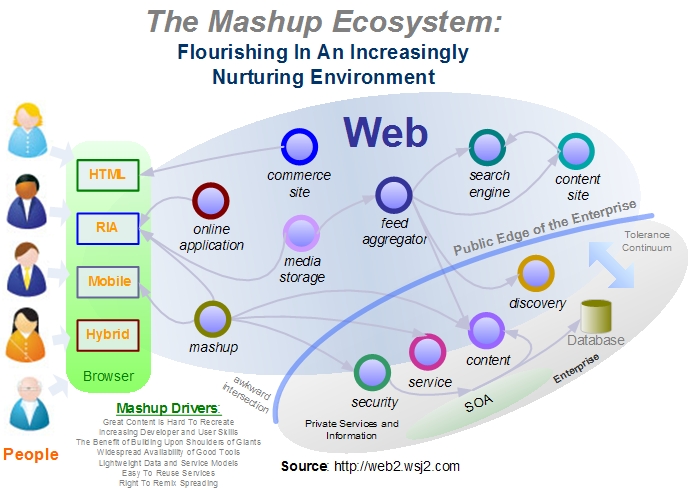
David Berlind has done an excellent job recently drawing the parallels between the modern Web and an operating system and I agree with him that the result is obvious: the ascendency of the Web as the first superplatform. A thing not dissimilar to the political concept of a superpower in that nothing else can really compete. Yet this is a superplatform that is encompassing and embracing since anything you connect to it becomes a true part of the whole. And using Web 2.0 design patterns and business models, we have a relatively clear guide that shows how to be a good citizen and contribute to the ecosystem for individual benefit. Yet everyone else benefits more overall, via something called a network effect. Some have noted recently that the democratization of content and services was a stated goal of the Web from the beginning. But it wasn’t until now, where aggregated services can become more valuable than the parts, where the effect finally becomes pronounced.
Part of it is that technology tends to get ahead of our uses for it. With Web 2.0 and mashups in particular, there was a multi-year lag between what was possible and when it actually happened. With pervasive and widespread connectivity, lots of bandwidth, growing comfort with creating and consuming user generated content (this being blogs in particular), the maturaton of online communities, rapidly improving Web skills, and awareness of what’s possible on the Web, and you have a complex but potent recipe for the people side of the Web to drive major improvements in the way the its is used, on a massive scale.
The technical side has improved recently too with lightweight service models like RSS making it extremely easy to wire things together, the proliferation of lots and lots of good Web services (partially driven by Ajax and RIAs in general, which demand pure services to function), and even tools and ready information to support creating mash-ups, has led us to a place where everything seems just about perfect for mashups to take off.
And people are certainly noticing. You can find mention of mashups in the mainstream press all the time. And Microsoft is holding the MIX 06 conference next month, one of the hottest tickets in the IT conference circuit this year, and it’s all about the burgening remix culture that mashups are heralding. Microsoft has even been spotted recently connecting the dots in a larger perspective and trying to bridge the closely related techniques of Web 2.0 and service-oriented architecture (SOA), something I’ve also talked aboutat length in the past. As many of you know, SOA is a popular model for creating an integrated architecture of systems within an organization, and then creating cross-cutting, composite applications out of the result. But the mashup ecosystem is poised doing the exact same thing on a global scale with more verve, speed, efficiency, and the factor that really counts, success.
But it’s not just a supply-side phenomenon or the purview of large software corporations. Not at all. Mashups are being driven in a very populist manner and people are actually using them. I routinely see mash-up lists hitting the del.icio.us popular page, for example. And great lists of Web 2.0 software like Fourio’s Web 2.0 Innovation Map, or Peter Cashmore’s enjoyable Mashable site, or especially TechCrunch routinely highlight what is possible (and indeed, this lists are only falling behind). I’ve said recently that creating software from scratch is going away more and more, and all of this is further proof. So, this brave new world of software is certainly exciting and sometimes terrifying, but in the end, it is indeed a compelling new future for software.
Where do you think mashups are going? Are they a fad or a final shift to a successful model for reusing services and content?
Sidenote: We’re always looking for great content for the brand-new Web 2.0 Journal. If you are a capable author and want to write feature articles, interviews, product reviews on Web 2.0 topics, please drop me a line.
